
Industry News
Stefano Braganti
Procore Groundbreak 2026: A Guide for Safety and Compliance Teams
Groundbreak 2026 runs October 21 to 22 in Orlando. What safety and compliance teams should see, what to ask in the Expo Hall, and how to plan the trip.

September 17, 2026 | 11 min read | Industry News
Key takeaways
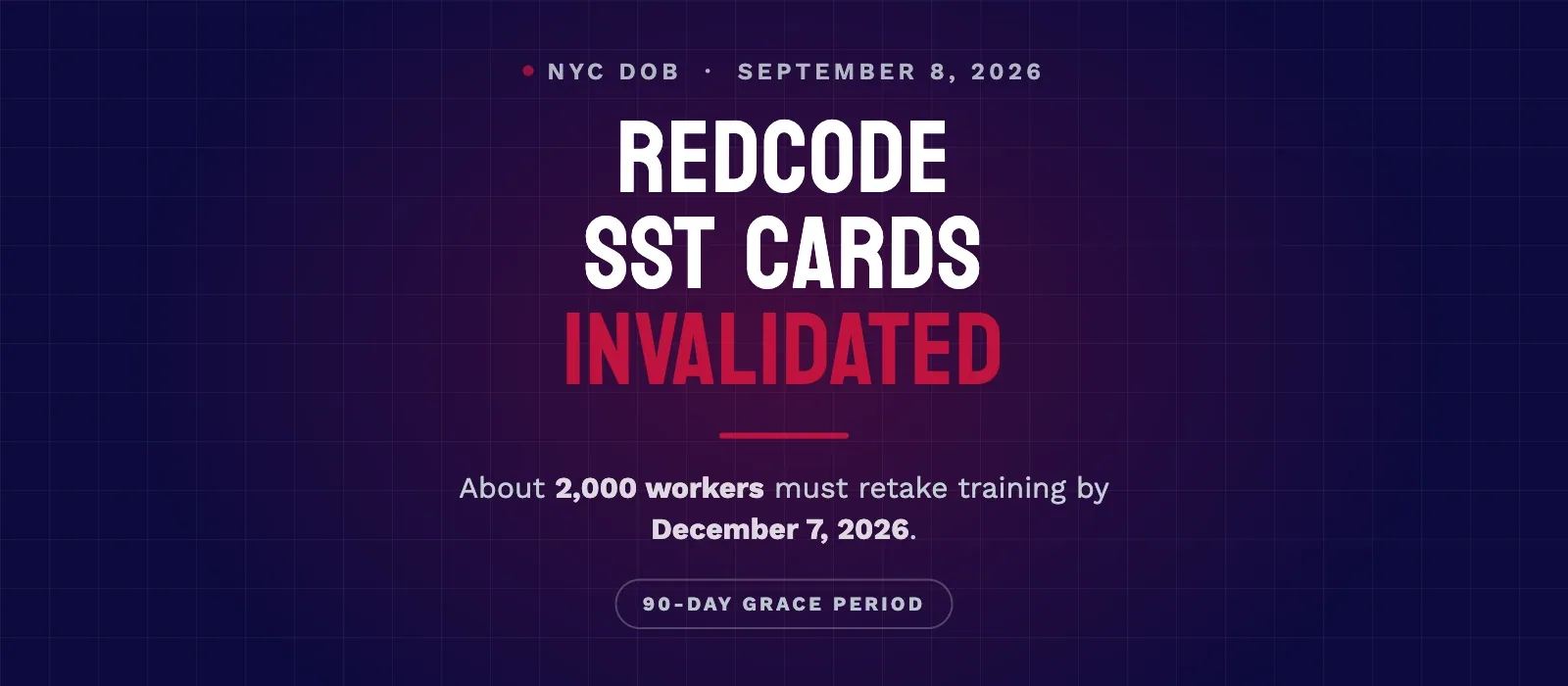
On September 8, 2026, the Department of Buildings and the Department of Small Business Services announced that RedCode Inc., a DOB-registered safety training course provider with locations at 529 McDonald Avenue in Brooklyn and 146-04 Hillside Avenue in Queens, had been indicted by the Brooklyn District Attorney's Office on fraud-related charges. Prosecutors allege that undercover investigators posing as construction workers were sold SST and OSHA cards for $500 each without completing any of the required training, and that workers signed attendance sheets for sessions they never attended.
DOB's response was immediate. RedCode is no longer an approved provider, every SST certificate it issued is invalid, and the roughly 2,000 workers who hold active RedCode-issued SST cards have until December 7 to retake the training and get a legitimate card. If you run projects in New York City, or you employ workers on them, the next 90 days include a piece of work that isn't on anyone's schedule yet.
Three things happened on September 8. RedCode was shut down as a course provider and can no longer operate in New York City or issue SST cards. Every SST certificate RedCode issued was invalidated. And DOB opened a 90-day grace period so affected workers can retake training through any registered course provider.
Two details from DOB's RedCode FAQ matter for how you read the rest of this. First, certificates and cards are different things: the certificates are invalid now, but affected SST cards, Worker Wallet certifications, and licensing certificates stay active during the grace period, and a RedCode card still scans as valid on a jobsite until December 7.
Second, DOB has been contacting workers with RedCode-issued cards since the announcement, and on September 14 its Course Provider Administration emailed affected workers a formal notice laying out the four cases and the Monday, December 7 deadline. Contractors started receiving forwarded copies from their workers the same day, and so did we. A worker who received that email is on DOB's list, which makes the email itself the fastest way to find out who's affected.
The scale of the program is worth holding next to this. Since Local Law 196 of 2017 made the 40-hour training mandatory in 2018, registered providers have issued SST cards to more than 450,000 people, representing more than 18 million hours of completed training, and building construction injuries fell from 759 in 2018 to 320 in the most recent year DOB reported — a decrease of almost 58 percent. RedCode itself had been an approved provider since April 2021 and issued about 2,000 SST cards tied to more than 7,000 certificates. DOB audits providers with undercover investigators and runs unannounced site inspections to check cards. This case came out of that.
DOB's FAQ defines four groups, and only the first is obvious from the card itself.
Group two is the one to worry about. A worker's SST card can carry another provider's name and still depend on RedCode training underneath it.
| Date | What Happens |
|---|---|
| September 8, 2026 | RedCode certificates invalidated. Grace period begins, with September 9 as day one. |
| Through Monday, December 7, 2026 | Affected SST cards, Worker Wallet certifications, and licensing certificates remain active and usable on jobsites. |
| December 8, 2026 | RedCode-issued SST cards revoked. Other providers' cards revoked if they relied on RedCode certificates and the training wasn't retaken. |
The grace period is the window for retaking training, and the deadline falls on a Monday — so the last weekend before it is the one every affected worker will try to book.
On December 8, SST cards issued by RedCode are revoked and can't be used on jobsites. DOB's worker notice phrases this as "at the end of the grace period on December 7," and its FAQ as December 8. Same moment, and December 7 is the last day a RedCode card scans. SST cards from other providers that relied on RedCode certificates are revoked unless the training was retaken. RedCode worker certifications come off the Worker Wallet. RedCode certificates stop satisfying DOB licensing requirements. OSHA cards naming RedCode's owner as instructor stop counting toward SST.
Under Local Law 196, an untrained worker found on a site that requires SST carries a $5,000 civil penalty — assessed to the site owner, the permit holder, and the worker's employer each. On December 8, a worker with a revoked card is an untrained worker.
Most contractors verify SST at onboarding by collecting a copy or a photo of the card. That was a defensible practice until this month. The RedCode action shows the problem with it: a document that was valid when it was uploaded tells you nothing about its status today, and DOB can act on a credential after the worker is already inside your workforce.
DOB has been moving credential verification to live data for exactly this reason. SST cards can be scanned with the DOB Training Connect app to confirm they're valid, and the Worker Wallet card consolidates a worker's qualifying certifications into one digitally verifiable card. The direction is one-way: verification against current DOB information, not against a photocopy in a folder.
For RedCode specifically, DOB's FAQ says the way to find out which certificates behind a card came from RedCode — including a card another provider issued — is to contact a registered course provider, who can determine what's missing. That's a per-worker inquiry, and on a project with 40 subcontractors it's a list somebody has to build.
The grace period is easy to misread. A worker whose card still scans today can enter your project today and be an untrained worker on December 8. If your employees work on SST-required sites, review them now, without waiting for the GC to ask. Workers with affected training should book replacement courses as soon as possible, through any registered course provider, and the free program through SBS is at 888-SBS-4NYC or nyc.gov/sst.
A worker who replaces RedCode worker certifications keeps the same Worker Wallet card. A worker whose SST card came from another provider keeps that card if all the required training is retaken by December 7. A worker with a RedCode-issued card needs a new card from a registered provider.
SafetyClerk was built around live worker compliance rather than document storage, which is the difference this case turns on. When a worker onboards, they tap or scan their SST card or Worker Wallet, and the platform's integration with DOB Training Connect associates the worker's available training and credential information with their digital profile, per company and per project.
Because that information sits on the profile, we're reviewing available training data for our clients now to identify workers whose records indicate potential exposure to the RedCode action, and notifying affected clients so they can start remediation well ahead of December 7.
If you're a SafetyClerk client and you receive an alert, review the workers on it and coordinate replacement training with the subcontractor. If you don't receive one, your records didn't show exposure in the data available to us, and DOB remains the authority for any individual worker.
The larger point outlasts RedCode. Collecting a card is a snapshot. Compliance is continuous: worker, verified identity, current training, current credentials, project requirements, and someone who finds out when any link in that chain changes. That's what contractor tracking in SafetyClerk is for: a worker's credentials sit on their profile with their expiration dates, and cards can be validated from both the app and the web instead of trusting whatever was filed at onboarding.
Start with DOB's September 14 email. It went to workers whose records include RedCode training, so anyone who received it is affected in one of the four ways above. For everyone else, a registered course provider can tell you which certificates behind a card came from RedCode.
Yes, through December 7, 2026. Affected cards remain active on jobsites during the grace period. On December 8, RedCode-issued cards are revoked.
It can be, if RedCode certificates were used to meet the training requirements for that card. DOB's FAQ says a registered course provider can determine which certificates behind a card came from RedCode. If the required training is retaken by December 7, the worker keeps that card.
No. DOB says workers only retake the training associated with the RedCode certificates. Other valid certificates stand.
Any DOB-registered course provider authorized to offer the needed courses — the worker doesn't have to return to the provider that issued the current card. The NYC Department of Small Business Services offers free SST training and cards through the Construction Site Safety Training Program, at 888-SBS-4NYC or nyc.gov/sst.
No. Replacing the certifications is enough. The RedCode certifications are removed from the card on December 8 if they haven't been replaced.
From December 8, DOB no longer accepts it toward SST requirements. The worker must retake OSHA training through a current OSHA training provider.
DOB is the authoritative source on this action and on any individual worker's status.
For questions about training requirements, contact a registered course provider or DOB Course Provider Administration at TrainingProviders@buildings.nyc.gov or (212) 393-2729. For free training, SBS at 888-SBS-4NYC or nyc.gov/sst.
If you want to see how many workers on your projects would show up on a list like this, and how the gate handles it on December 8, a demo takes 30 minutes.

Stefano Braganti
Co-Founder and CEO of SafetyClerk, passionate about construction, real estate, technology and engineering.


Industry News
Stefano Braganti
Groundbreak 2026 runs October 21 to 22 in Orlando. What safety and compliance teams should see, what to ask in the Expo Hall, and how to plan the trip.
Industry News
Stefano Braganti
DOB invalidated RedCode SST certificates. Who's affected, the December 7, 2026 deadline, and how NYC contractors find exposed workers now.
Industry News
Ji-Yeon Park
OSHA updates its Small Business Safety and Health Handbook—what changed, new checklists, and how to align your program.
SafetyClerk is the construction management platform that makes safety compliance, and risk management of your job site simple and visible in one click.


Stay on
the loop!
ConstructionClerk - 2026 - All rights reserved
ConstructionClerk - 2026 - All rights reserved