Construction Labor Shortage 2026: Why Worker Skills, Certifications and Training Data Matter More Than Ever
October 9, 2026 | 12 min read | Industry News
Key takeaways
ABC estimates construction needs 349,000 net new workers in 2026, most of them to replace retirees. In the AGC and NCCER survey fielded this July and August, 88 percent of firms with craft openings say those jobs are as hard or harder to fill than a year ago.
The shortage is also a safety problem. First-year employees account for 44 percent of construction injuries in Travelers' 2026 Injury Impact Report, and 83 percent of contractors see turnover among new field hires in their first 90 days.
Half of contractors say candidates lack the skills, certificates, or licenses the job needs. Worker-level data on tenure, credentials, training, and turnover by subcontractor is how a GC or a sub runs a site where the crew keeps changing.
The construction labor shortage in 2026 is smaller on paper than it was two years ago and harder to manage on the ground. Associated Builders and Contractors estimates the industry needs 349,000 net new workers this year, the lowest annual gap it has projected since 2021, and most of that demand comes from retirements rather than new work.
The contractors AGC and NCCER surveyed this summer still describe a market where most firms have craft openings that are hard to fill, and many new hires leave early. For a safety director or a subcontractor owner, that means more people on site who are new to the company, the crew, or the trade, and less time to train them.
"You keep hiring because you don't have enough people. You don't have time to train them. So they're less productive, and they're less safe. Period," says SafetyClerk co-founder Stefano Braganti. This guide covers what the 2026 numbers say, why the shortage shows up in injury data, and how GCs and subs use worker skills, certification, and training data to keep a site safe while its workforce keeps turning over.
The 2026 Labor Shortage in Numbers
Figure
Number
Source
Net new workers the industry needs
349,000, rising to 456,000 in 2027
ABC workforce model, January 15, 2026
Firms with open hourly craft positions
87%
AGC and NCCER, July to August 2026
Firms with craft openings that are as hard or harder to fill than a year ago
88%
AGC and NCCER
Firms saying candidates lack needed skills, certificates, or licenses
50%
AGC and NCCER
Firms with turnover among new field hires in the first 90 days
83%
AGC and NCCER
Share of construction injuries involving first-year employees
44%
Travelers 2026 Injury Impact Report, claims from 2021 to 2025
ABC's model says a majority of this year's demand for new workers comes from retirement, even with the AI infrastructure buildout underway, and the need climbs again in 2027 as construction spending growth resumes. The AGC and NCCER 2026 Workforce Survey, with 1,830 respondents, shows where it hurts.
Electricians top the list of hard-to-fill crafts, cited by 81 percent of firms with electrician openings. Among salaried roles, 75 percent of firms with superintendent openings report difficulty finding qualified candidates. Forty-two percent say shortages of their own workers or their subcontractors' workers have delayed projects, and only 26 percent report no significant delays at all.
Two newer pressures run through the same survey. Twenty-eight percent of firms did data-center work in the past year, and among firms reporting its effects, 58 percent say it increased competition for skilled workers and 30 percent say it increased turnover. On immigration enforcement, 71 percent of firms report no impact in the past six months, and 29 percent report at least one direct or indirect effect, including 16 percent whose subcontractors lost workers.
"People don't want to get into a trade anymore," Stefano says. "Almost every subcontractor is struggling to find people."
Age distribution of SafetyClerk's active users over the past 12 months, including age groups, user roles, and average age by role.
Why a Short-Handed Site Is a Less Safe Site
Travelers analyzed more than 1.2 million workers' comp claims from 2021 through 2025 for its 2026 Injury Impact Report. First-year employees account for about 37 percent of all injuries and 34 percent of claim costs, despite being a much smaller share of the workforce. In construction, first-year employees account for 44 percent of injuries, and an injured construction worker misses an average of 114 workdays, the longest recovery of any industry in the report. Among its recommendations to employers: strengthen onboarding and safety training for new hires.
"New people are always less safe on the job," Stefano says. "Imagine a soccer team that's been playing together. You get a new guy. He doesn't know how to play with the others."
The AGC data suggests why the new guy keeps arriving. When 42 percent of firms say new hires fail to show up or quit shortly after starting, the crew never finishes learning to play together. Every departure resets the clock on the person who replaces them.
Turnover: The Number Few Sites Track
"It's one thing to have 100 people on the jobsite," Stefano says. "It's another thing to have a different 100 people on the jobsite every day."
On SafetyClerk projects, the access-control data does the counting. Every check-in at the gate is tied to a worker and a company, so a GC can see the turnover rate for each subcontractor on the project, the same way it sees headcount. Stefano says there's a trend between a subcontractor's turnover rate and the incidents it registers.
The practical use is simple. Put turnover by subcontractor on the weekly meeting agenda next to headcount and incidents, and treat a sudden jump the way you'd treat a jump in near misses. Watched that way, it works as a leading indicator.
Short-Service Employees: Flag, Mentor, Graduate
Short-service employee programs have been common in oil and gas for years. They typically cover anyone with less than six months with their current employer or in their current job, and they usually come with three rules: the worker is visibly identified on site, paired with an experienced mentor, and formally graduated out of the program once they've shown they can work safely.
Some SafetyClerk clients already run a version of it. "One of our subcontractors gives them a green vest instead of yellow for any worker that has been less with their employer for less than 90 days," Stefano says. "They're monitored on site, they have a mentor, and they're observed for whatever it takes, a day, five, ten, fifteen. When they're deemed safe, they graduate them from short-service employment."
"We didn't have it," Stefano says. "One of our clients brought it up because they were doing that on paper." During onboarding, a GC can ask each worker whether they've been with their company longer than a set number of days. A worker who answers no is flagged as a short-service employee until someone graduates them, and every superintendent and safety manager on the project can see who's still new.
It lines up with what contractors told AGC they're doing about early turnover: structured onboarding, regular check-ins, formal jobsite orientations, safety-focused onboarding, and mentor or buddy programs.
Verify Skills and Certifications Before the First Shift
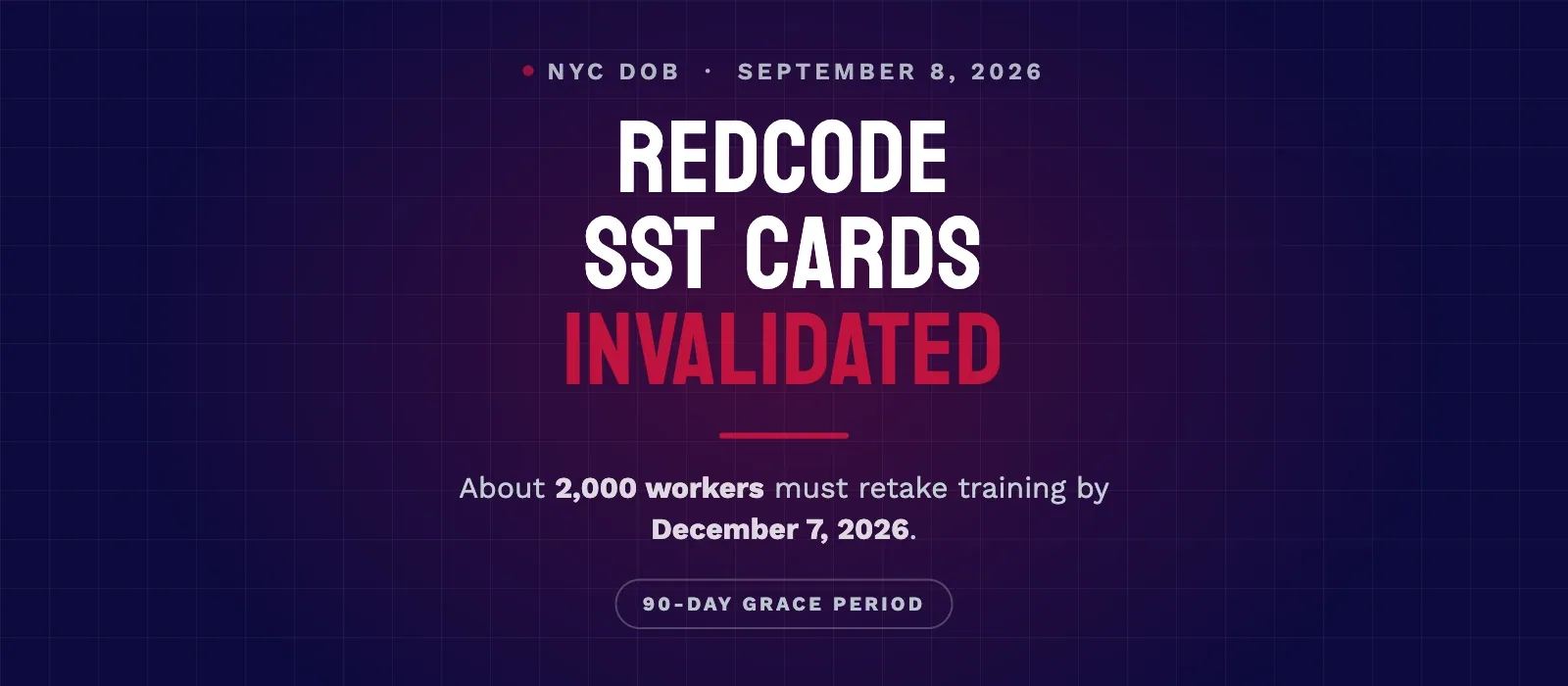
Half of the contractors in the AGC survey say candidates aren't qualified because they lack needed skills, certificates, or licenses. That's the most cited reason firms give for struggling to fill jobs. In a tight market, it's tempting to take the card a new hire carries at face value, and a credential can also change after the worker is already on site. In September, New York City's Department of Buildings invalidated every Site Safety Training certificate issued by a single training provider, and about 2,000 workers holding that provider's cards have until December 7 to retrain. The RedCode article covers what that meant for contractors.
The fix is to treat credentials as data about the worker. In SafetyClerk, certifications live on each worker's profile, and access rules based on qualifications and certifications decide who gets through the turnstile. In New York, a worker's SST card or Worker Wallet is checked against DOB Training Connect data when it's first connected to the profile. Wesbuilt Construction Managers imports worker certifications into each worker's profile, because it wants confidence that every worker has the required training before stepping on site.
Give Every Foreman Today's Hazards
Supervisors are hard to hire, too: 74 percent of firms with openings for project managers and supervisors report difficulty filling them. Stefano's point is that a foreman knows what the crew is doing today, even when he doesn't have every risk and control for that task memorized.
SafetyClerk handles that with the subcontractor's own job hazard analyses. The sub builds its JHA library by activity in SafetyClerk. Every morning, the foreman picks the day's activities in the pre-task plan, pulling wire or demolishing a wall, and SafetyClerk pulls the risks and controls for those activities from the library so the foreman can walk the crew through them. "Make it simple for the foreman to access the information they already have," Stefano says.
Toolbox talks carry the other half of the load. In Stefano's model, a toolbox talk builds the base knowledge, such as how to set up and climb a ladder, and the pre-task plan applies it to today's task.
What Worker Data Tells a Subcontractor
For a subcontractor, the same records answer a business question. SafetyClerk's time tracking produces labor-cost reports per site and per worker. Load each worker's hourly cost, Stefano says, and a sub can compare the productivity of crews across similar jobs, then look at it against how long each worker has been with the company.
That's the case a sub brings to a GC. SafetyScore scores workforce readiness from training, certifications, orientations, and daily activity, and lets a subcontractor show safety and productivity numbers during bidding. In a market where GCs are short on reliable subs too, a documented, stable, trained crew is a competitive advantage.
"You need to become smarter, if you're a subcontractor or a general contractor," Stefano says. In his view, the shortage won't ease until robots take on part of the work.
Will Robots Close the Gap?
One SafetyClerk client is already testing robots that tape and spackle drywall. "CMU installation and drywall installation are going to be partially replaced," Stefano says. "Ten years for sure. I'll bet on five."
The contractors in AGC's survey are more measured. Fifty-one percent expect AI and robotics to have a positive effect on construction over the next five years, and 8 percent expect a negative one. The effects they cite most often are automating repetitive or error-prone tasks, making workers more productive, and improving safety. AGC's own conclusion is that technology is unlikely to eliminate the industry's need for people, and that it will change the skills construction workers need.
Both views point the same way for a safety program. As tasks shift between people and machines, knowing exactly what each worker is trained and certified to do matters more.
A Checklist for GCs and Subcontractors
Track turnover by subcontractor every week, from gate data rather than sign-in sheets.
Flag short-service workers at onboarding, make them visible on site, assign a mentor, and graduate them on purpose.
Verify certifications against the issuing source, and recheck them when the source changes.
Run a pre-task plan every morning from the subcontractor's own JHA library, by activity.
Choose toolbox talks by the work underway and the near misses on site, not by the next number on a list of 52.
For subcontractors: measure productivity by crew and by tenure, and bring the numbers to prequalification.
Frequently Asked Questions
How many construction workers are needed in 2026?
Associated Builders and Contractors estimates the industry needs 349,000 net new workers in 2026 and 456,000 in 2027. A majority of this year's demand comes from replacing retiring workers rather than from new construction.
Why does the labor shortage make jobsites less safe?
Because the workforce gets newer. First-year employees account for 44 percent of construction injuries in Travelers' 2026 Injury Impact Report, and 83 percent of contractors in the AGC and NCCER survey see turnover among new field hires in their first 90 days, so the least experienced workers keep being replaced by workers with even less time on the crew.
What is a short-service employee?
A worker with limited time with their current employer or in their current job, typically under six months. Short-service programs, common in oil and gas and used by some construction contractors, identify these workers visibly, pair them with a mentor, and graduate them once they've shown they can work safely.
How can a GC check subcontractor workers' certifications?
Keep certifications on each worker's profile rather than in a folder, verify them against the issuing source where one exists, and set access rules so a worker without the required credential can't get through the gate. In New York City, SST cards can be verified through DOB Training Connect.
Does high turnover increase incident rates?
The injury data points that way. First-year employees account for an outsized share of construction injuries, and Stefano says there's a trend between a subcontractor's turnover rate and its registered incidents. Measuring turnover by subcontractor is the first step to managing it.
Will robots solve the construction labor shortage?
Not on their own. In AGC and NCCER's 2026 survey, 51 percent of contractors expect AI and robotics to help the industry, most often by automating repetitive tasks and improving productivity and safety, and AGC concludes the technology is unlikely to eliminate the need for people. Stefano expects robots to take over tasks such as drywall and CMU installation within five to ten years.
Know who's on your site, how long they've been there, and what they're qualified to do.
See onboarding, credential checks, and turnover by subcontractor running on your projects. A demo takes 30 minutes.
SafetyClerk is the construction management platform that makes safety compliance, and risk management of your job site simple and visible in one click.