Key takeaways:
- Under OSHA's multi-employer citation policy, a GC can be cited for a subcontractor's hazard if it didn't take reasonable care. That means inspections of appropriate frequency, a system for promptly correcting hazards, and graduated enforcement with follow-up.
- GCs usually lose track at three points: onboarding, where each subcontractor brings 20 to 30 documents, worker certifications, and the daily records every company produces on site.
- Subcontractor management works when every stage runs on the same record: what you check before you award, what you collect before the first worker arrives, what you enforce every day, and what you measure before you hire that sub again.
A general contractor on a mid-size commercial project might run 10 subcontractors. On a high-rise, it can be 50. Each one brings its own workers, insurance, safety program, equipment, and paperwork, and each one can create a hazard the GC answers for. Subcontractor management is how a GC keeps all of that under control: vetting subs before they're hired, collecting what's needed before their crews arrive, enforcing the rules every day, and measuring who performed. This guide covers each stage, drawing on SafetyClerk co-founder Stefano Braganti's years as a superintendent and construction manager in New York City.
What OSHA Expects From a GC
On a construction site with several employers, OSHA can cite more than one of them for the same hazard. Its multi-employer citation policy, CPL 02-00-124, names four roles:
- the employer that created the hazard
- the employer whose workers were exposed
- the employer responsible for correcting it
- the controlling employer, usually the GC, with general supervisory authority over the site
A controlling employer must exercise reasonable care to prevent and detect violations. The bar is lower than for the employer whose own workers are exposed. A GC isn't normally expected to inspect as often, or to know the trade as well, as the subcontractor it hired. But the policy is specific about what reasonable care looks like. OSHA asks whether the controlling employer:
- Conducted periodic inspections of appropriate frequency. How often depends on the scale and pace of the work, and on the subcontractor's track record. More frequent inspections are normally needed when a sub has a history of non-compliance.
- Implemented an effective system for promptly correcting hazards.
- Enforced the subcontractor's compliance with an effective, graduated system of enforcement and follow-up inspections.
All three leave a record, or they don't. When OSHA asks, the GC's defense is the documented inspections, corrections, and enforcement steps.
Where GCs Lose Track First
Stefano starts with onboarding:
Note: "Every time you award a subcontractor on a project, you need to collect tons of documentation from the sub."
He puts the number at 20 to 30 documents per subcontractor, depending on the trade. The list runs from a W-9 and insurance certificates to a company safety manual, a site-specific safety plan, procedures for specific hazards, and a fall protection plan. Done by email and spreadsheet, that alone eats days.
Worker certifications come next. Every worker from every sub has to hold the right, current certifications for the work they're doing, and that changes as crews rotate.
Then the daily records. Every company produces its own paperwork every day: pre-task plans first, then equipment checklists, hot work permits, and permits for work like removing temporary netting. Each needs to be done, signed, and findable.
Stefano remembers what managing that by hand looked like:
Note: "It's almost impossible without a digital solution to be sure that you're complying with all the requirements."
Beyond paperwork, superintendents struggle with simple visibility: how many people each sub has on site today, where they're working, and what got done. Stefano adds scheduling and material deliveries to the list of hard problems. A floor can't go up if the material isn't there. SafetyClerk doesn't handle scheduling, he's quick to say. It handles the people side: who's on site, whether they're cleared to be there, and what they've signed.
Before You Award: Prequalification
The cheapest subcontractor problem to fix is the one you never hire. Prequalification usually covers:
- Safety performance data, such as TRIR, DART, and EMR, where your contracts call for it
- The safety program, and whether it fits the scope of work
- Insurance that meets your contract requirements
- Your own history with that sub: how its crews performed the last time, how fast it closed corrective actions, and whether it sent its best crews or its worst
That last item is the one most GCs don't have in a usable form. A sub's paperwork can look perfect while its field record on your last three projects says otherwise. When your observations, corrective actions, and incidents live in one system, a sub's history on your projects becomes part of the decision.
Before the First Worker Arrives: Onboarding
Collect everything before the first worker walks on site. After that, you're chasing paperwork from a crew that's already working. What to collect:
- W-9
- Certificates of insurance, for each coverage the contract requires, plus required endorsements such as additional insured or
- Wrap-up enrollment, on CCIP or OCIP projects
- Company safety manual and site-specific safety plan
- Procedures for the scope's specific hazards, and a fall protection plan
- Training and certifications for the workers assigned
- Named competent persons, by area of work
- Safety performance data your contract asks for
- Emergency contacts
The insurance vetting gap. One gap deserves its own attention. Stefano sees crews arrive for orientation before procurement has approved their insurance, because the superintendent assumes that if the PM sent them, the paperwork is done. Catch it at orientation. If the company isn't in the project's approved records, the superintendent should know before the crew starts work.
Every Day on Site: Compliance and Accountability
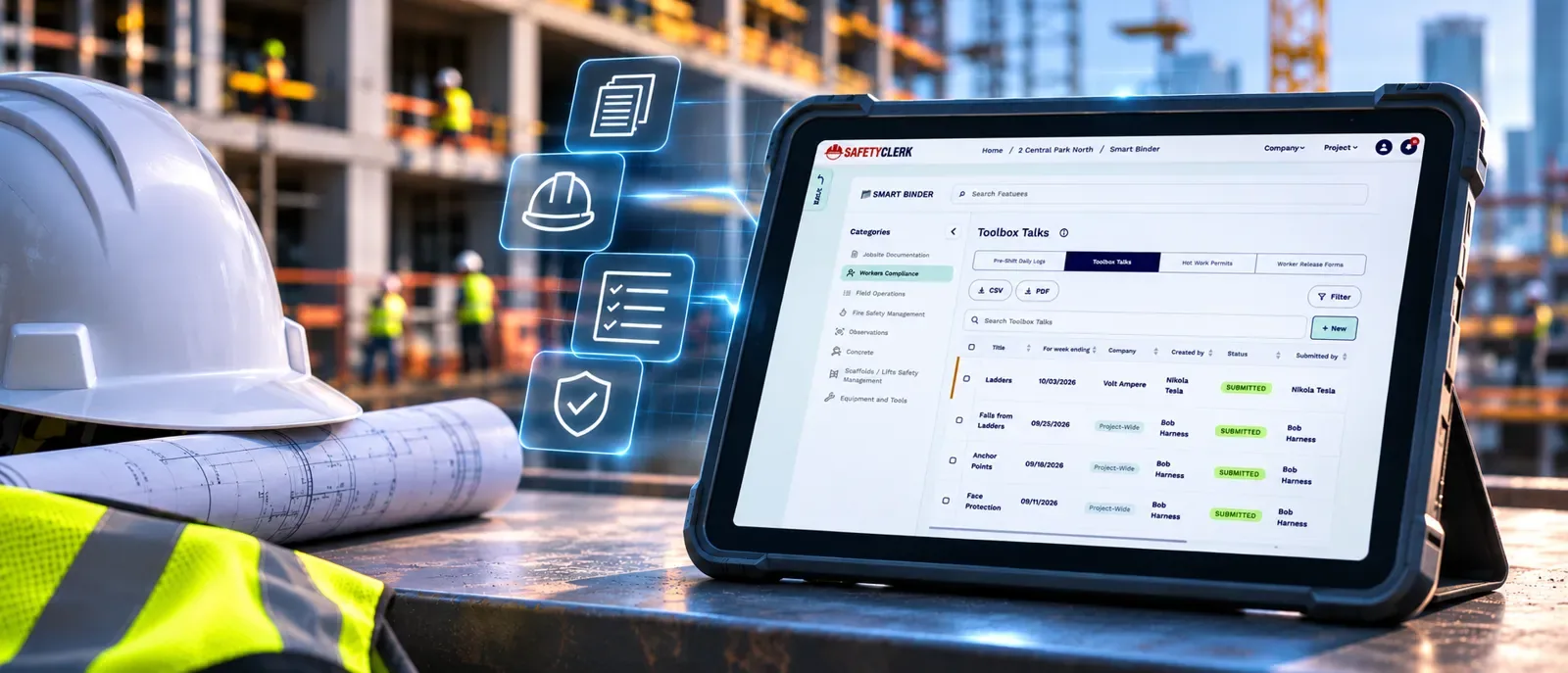
Credentials at the gate. Expired certifications and lapsed insurance should stop at the turnstile, before anyone climbs. On SafetyClerk projects, access settings can keep out workers with expired cards or missing certifications or orientations, and workers from companies with lapsed insurance.
The daily records. Each subcontractor's pre-task plans and equipment checks get done inside the GC's project, by the sub's own people, so the GC sees them without collecting them. Permits, including hot work and netting removal, work the same way.
Observations with an owner. Reasonable care depends on this part most, and it's where Stefano's approach lines up with OSHA's policy almost point for point. When the safety manager sees broken netting on a guardrail, the observation goes straight to the company responsible for that netting, without waiting for an end-of-day report. They get notified, fix it, and close it with a photo. That's the system for promptly correcting hazards.
The follow-up is built in too. If an assigned observation isn't resolved the same day, SafetyClerk starts emailing the subcontractor's office the next day. That's a graduated step of enforcement, with a record of every step. And because the time each company takes to close an observation gets measured, the GC knows which subs need more frequent inspections, which is the factor OSHA's policy ties inspection frequency to.
Positive observations count too. Stefano recommends recording what subs do right as well as what they do wrong, and broadcasting it to the whole site. He says SafetyClerk has seen negative observations go down on projects that use positive ones.
Training that follows the trend. Every observation rolls up into a category, such as falls, electrical, or struck-by. When one sub's observations trend toward a category, SafetyClerk can suggest a toolbox talk on that topic for that sub's crews.
After the Job: Measuring Subcontractor Performance
By closeout, a GC that ran the stages above has a performance record for every sub:
- how fast it closed observations, and how many it had, by category
- how its crews compared with the same trade on other projects
- whether its workers' credentials and insurance stayed current
- its incidents and near misses
That record answers the question every GC asks at the next bid: would we hire them again? It also travels. Insurance data and worker records follow a subcontractor from one of your jobsites to the next, so the next project starts from what you already know.
What to Look for in Subcontractor Management Software
Whatever you're considering, ask:
- Can subcontractors onboard their own companies and workers into your project, so you're not collecting documents by email?
- Do insurance status and worker credentials reach the turnstile, so a lapse stops someone at the gate?
- Does it catch a company at orientation if procurement hasn't approved it?
- Does each sub's daily paperwork, such as pre-task plans, equipment checks, and permits, happen inside your project?
- Do observations go straight to the responsible company, with a deadline and an escalation?
- Can you compare subcontractors and crews across projects?
- Does a sub's record carry over to your next project?
How SafetyClerk Helps
One project, every subcontractor. SafetyClerk puts every subcontractor's workers, credentials, insurance, and daily records on one system inside the GC's project.
Credentials and insurance at the gate. Each worker's certifications, orientations, and training live on their profile, with alerts before documents expire. Insurance management tracks certificates of insurance from onboarding and carries them across jobsites. The turnstiles enforce both, and keep a live record of who's on site.
Accountability and performance. Observations go straight to the responsible subcontractor, with next-day escalation to its office. SafetyClerk's risk management and SafetyScore track the safety performance of every subcontractor on site, benchmark crews, and alert you when performance falls below the level you set.
Proof from the field. On AECOM Tishman's 21-story tower at 729 Second Avenue, SafetyClerk managed 1,140 workers from 52 subcontractors, with 36,129 pre-shift sign-offs and 4,572 toolbox talk acknowledgments.
Frequently Asked Questions
What is subcontractor management in construction? It's how a general contractor vets, onboards, oversees, and evaluates the subcontractors on its projects: insurance and documents before work starts, credentials and safety compliance every day, and performance tracking afterward.
Can a GC be cited for a subcontractor's safety violation? Yes. Under OSHA's multi-employer citation policy, a controlling employer can be cited if it didn't exercise reasonable care to prevent and detect violations. That means periodic inspections of appropriate frequency, an effective system for promptly correcting hazards, and an effective, graduated system of enforcement and follow-up inspections.
What documents should a GC collect from subcontractors? Typically:
- a W-9
- insurance certificates and endorsements
- wrap-up enrollment, where it applies
- the company safety manual and a site-specific safety plan
- hazard procedures and a fall protection plan
- training and certifications for the assigned workers
- named competent persons
- safety performance data
Stefano puts it at 20 to 30 documents per subcontractor, depending on the trade.
How do you track subcontractor worker certifications? On each worker's profile, with alerts before expiration, and enforced at the gate, so a worker with an expired certification can't reach the work.
How do you hold subcontractors accountable for safety hazards? Assign each observation to the company responsible for fixing it, set a deadline, escalate to the sub's office when it isn't closed, and measure how long each company takes. That record is also what OSHA's reasonable care test looks for.
What should subcontractor management software do? Onboard subs and their workers into your project, enforce insurance and credentials at the gate, keep each sub's daily records inside your project, route observations to the responsible company with escalation, and compare subcontractors across projects.
This article provides general information and isn't legal advice. States with their own OSHA-approved plans can have additional requirements.
Run every subcontractor on one record. A SafetyClerk demo takes 30 minutes. Book a Demo









 Review us on G2
 Review us on Capterra