Key takeaways:
- Construction safety documentation comes in three layers: records federal OSHA requires, records your city, state, owner, or GC requires, and records that prove your safety program actually runs. Most of what matters on a jobsite falls in the second and third layers.
- Twelve records cover a construction safety program: orientations, worker training, JHAs, toolbox talks, pre-shift meetings, daily logs, inspections, observations, corrective actions, incidents, subcontractor documentation, and worker credentials.
- The aim of all of it is a verifiable record of what's actually happening on the jobsite, captured where the work happens, by the people doing it, when it happens. Records captured that way also become a live picture of risk across every site.
Every contractor keeps safety records. The question is whether those records can answer the hard questions when they come: who was on site, what they were trained on, what hazards they were told about that morning, who inspected the scaffold, and what happened to the hazard someone reported last Tuesday. An inspector, an owner, an insurer, or a lawyer will eventually ask, and the answer is either in your records or it isn't. This guide covers the 12 records every construction contractor should keep, what federal OSHA requires for each, what a good record shows, and how long to keep it.
The Three Layers of Safety Documentation
Layer 1: what federal OSHA requires. A short list of specific records, including:
- injury and illness logs
- certain training certifications and fit tests
- crane inspection records
- a handful of qualification documents
Layer 2: what your city, state, owner, or GC requires. This is where most jobsite paperwork comes from. In New York City, the Department of Buildings expects site safety logs, orientation records, and inspection documents. Owners and GCs add JHAs, pre-task plans, and prequalification data.
Layer 3: what proves your program works. Records that no rule requires, but that show what happened when an inspector asks a worker about a hazard, or when a claim arrives two years later. OSHA's Recommended Practices for Safety and Health Programs in Construction build a program around exactly these records:
- inspections that find hazards
- investigations of injuries, incidents, and near misses
- workers reporting hazards without fear of retaliation
- tracking whether corrective actions get done on time
On a multi-employer site, layer 3 carries extra weight. OSHA can cite more than one employer for the same hazard, and a GC with control of the site is expected to use reasonable care to prevent and detect violations. Records are how you show you did.
The 12 Records Every Contractor Should Keep
1. Site Orientations
What's required. Federal OSHA requires every employer to instruct each employee in recognizing and avoiding unsafe conditions (1926.21(b)(2)), but no federal standard requires an orientation record. New York City is stricter in practice. In December 2024, DOB issued violations against a construction superintendent for, among other failures, not having adequate site safety orientation records for the workers on site.
What a good record shows.
- The worker, their company, and their trade
- The language the orientation was given in
- The date and time
- The orientation version and who delivered it
- The worker's own acknowledgment
Keep it. There's no federal minimum. Keep it at least as long as the project's claim window, and in New York City, for as long as DOB requires site safety documents.
2. Worker Training
What's required. Several training topics require written records, including:
- fall protection certifications (1926.503(b))
- forklift operator certifications (1910.178(l)(6), through 1926.602(d))
- crane operator evaluations (1926.1427(f)(6))
- signal person qualifications (1926.1428)
- respirator fit tests (1910.134(m)(2))
- confined space training (1926.1207(d))
Health standards such as asbestos add their own training record rules. Other training is required with no record requirement, including hazard communication, scaffold training (1926.454), and ladder training (1926.1060). OSHA's 2010 training policy adds one more test. Training must be in a language and vocabulary workers understand, and inspectors look beyond the paperwork to check.
What a good record shows.
- The worker, the topic, and the content version
- The date and time
- The trainer and their qualification
- The language used
- The worker's signature
Keep it. It depends on the standard: the latest fall protection certification, fit tests until the next test, and crane operator evaluations at the worksite while the operator is employed.
3. JHAs and Pre-Task Plans
What's required. No federal OSHA standard requires a job hazard analysis or pre-task plan. OSHA's recommended practices list job hazard analyses among the tools for identifying hazards, and many owners and GCs make them a contract requirement.
What a good record shows.
- The specific task, its hazards, and the controls for each
- The date
- Each crew member who reviewed the plan before starting
Keep it. There's no federal minimum. It's the best evidence that a crew reviewed the hazards of the work they actually did that day.
4. Toolbox Talks
What's required. No federal standard requires a toolbox talk record. But toolbox talks often deliver training that standards do require, such as the general safety instruction under 1926.21(b)(2), and the sign-in sheet is how you show it happened.
What a good record shows.
- The topic and content version
- The trainer
- The language
- The date and time
- Each attendee's own signature
Keep it. There's no federal minimum. For talks that keep training current, keep the record as long as the training record it supports.
5. Pre-Shift Meetings
What's required. Federal OSHA doesn't require pre-shift meetings. In New York City, pre-shift and weekly safety meetings are among the site safety documents DOB expects to see.
What a good record shows.
- The date, the crew, and the work planned
- The hazards discussed
- Each worker's sign-off, captured when they received it
Keep it. There's no federal minimum. In New York City, electronic site safety documents must stay accessible for up to seven years after the job.
6. Daily Logs
What's required. Federal OSHA doesn't require a daily log. New York City's site safety documents include the site safety log, and the superintendent and site safety manager logs.
What a good record shows.
- Who was on site, by company
- The work performed
- Conditions on site
- Inspections done
- Incidents and visitors
Keep it. There's no federal minimum. The daily log is the record that ties the day together when a dispute or claim arises.
7. Inspections
What's required. OSHA requires frequent and regular inspections of job sites, materials, and equipment by competent persons (1926.20(b)(2)). Specific standards set the schedule:
| What's inspected | How often | Standard |
|---|
| Scaffolds | Before each shift | 1926.451(f)(3) |
| Excavations | Daily, before work starts | 1926.651(k)(1) |
| Cranes | Each shift, monthly, and annually | 1926.1412 |
| Aerial lift controls | Each day before use | 1926.453(b)(2)(i) |
| Personal fall arrest systems | Before each use | 1926.502(d)(21) |
| Ladders | Periodically, by a competent person | 1926.1053(b)(15) |
Most of these require the inspection without requiring a written record. Crane monthly and annual inspections are the exception. In New York City, sidewalk shed and scaffold inspection documents are part of the required site safety record.
What a good record shows.
- The equipment or area
- The inspector's name and qualification
- The date and time
- What was found, and the corrective action it led to
Keep it. Crane monthly inspection records for three months, and annual records for twelve. There's no federal minimum for the rest, so keep them as long as the project's claim window.
8. Observations
What's required. Nothing in the OSHA standards requires an observation record. OSHA's recommended practices are built around workers reporting hazards, incidents, and near misses without fear of retaliation, and around inspections that find hazards before they hurt someone.
What a good record shows.
- What was seen and where
- Who reported it
- A photo
- How serious it is, and who it's assigned to
Keep it. Until the corrective action is closed, then with the project records.
9. Corrective Actions
What's required. When OSHA cites a violation, the employer must certify within 10 calendar days after each abatement date that it was corrected, with the date and method (1903.19). Beyond citations, OSHA's recommended practices treat the timely completion of corrective actions as a leading indicator worth tracking. On a multi-employer site, a record of hazards found and fixed is part of how a GC shows reasonable care.
What a good record shows.
- The observation or inspection it came from
- Who owns it, the due date, and the closed date
- How it was fixed, ideally with a photo
Keep it. At least as long as the observation or inspection it closes.
10. Incidents and Near Misses
What's required. Recordable injuries and illnesses go on the OSHA 300 Log and a 301 incident report within seven calendar days. The year is summarized on the 300A. Fatalities have to be reported to OSHA within 8 hours, and in-patient hospitalizations, amputations, and losses of an eye within 24. Near misses aren't required to be recorded, but OSHA's recommended practices call for investigating them, because they point to the same hazards that cause injuries.
What a good record shows.
- What happened, when, and where
- The people involved
- The treatment
- The investigation and its root causes
- The corrective actions that followed
Keep it. The 300 Log, 300A, and 301s for five years after the end of the year they cover (1904.33). The full process is in our guide to OSHA Forms 300, 300A, and 301.
11. Subcontractor Documentation
What's required. No single standard lists what a GC must collect from its subcontractors, but the multi-employer citation policy makes it matter. Owners and insurers often require insurance certificates and safety performance data such as TRIR and DART rates.
What a good record shows, for each subcontractor.
- Its safety program
- Training and certifications for its current scope
- Its named competent persons
- Its inspection records and open corrective actions
- Its insurance certificates
Keep it. For the life of the project and its claim window.
12. Worker Credentials
What's required.
- Crane operators must be certified or qualified (1926.1427).
- Signal persons need documented qualifications (1926.1428).
- In New York City, Local Law 196 requires Site Safety Training cards for workers on many jobsites.
- Elsewhere, some states and many owners require OSHA 10-hour or 30-hour cards.
What a good record shows.
- The card or credential type and its number
- The holder
- The expiration date
- When and how it was verified
Checking before the worker reaches the work matters more than filing the copy afterward.
Keep it. For as long as the worker is on the project, and with the project records after that.
The Documentation Checklist
| Record | Federal OSHA | Other common requirements | Keep at least |
|---|
| Site orientations | Instruction required (1926.21(b)(2)), no record | NYC DOB orientation records | No federal minimum |
| Worker training | Written records for fall protection, forklifts, crane operators, signal persons, confined spaces, and respirator fit tests, among others | Owner and state requirements | Varies by standard |
| JHAs and pre-task plans | Not required | Owners and GCs | No federal minimum |
| Toolbox talks | Not required | Owners and GCs | No federal minimum |
| Pre-shift meetings | Not required | NYC DOB site safety documents | Up to 7 years for NYC electronic records |
| Daily logs | Not required | NYC DOB site safety logs | Up to 7 years for NYC electronic records |
| Inspections | Required for scaffolds, excavations, cranes, aerial lifts, fall arrest systems, and ladders. Written records for crane monthly and annual inspections | NYC sidewalk shed and scaffold inspections | Crane monthly 3 months, annual 12 months |
| Observations | Not required | Recommended by OSHA | Until closed |
| Corrective actions | Abatement certification for cited violations (1903.19) | Recommended by OSHA | With the record it closes |
| Incidents | OSHA 300, 300A, and 301, plus severe-injury reports | Insurers and owners | 5 years (1904.33) |
| Subcontractor documentation | Reasonable care under the multi-employer policy | GCs, owners, and insurers | Life of the project and claim window |
| Worker credentials | Crane operator certification and signal person qualification | NYC SST cards, and OSHA 10 or 30 where required | While the worker is on the project |
Where there's no federal minimum, set a retention policy with your insurer or counsel. Claims can arrive long after the job closes.
Digital Safety Documentation
Paper fails in the same places every time:
- illegible names
- signatures added after the fact
- sheets lost or soaked
- no record of when anyone signed
- binders that end up in off-site storage
Digital safety documentation holds up when it's built on four things:
- Worker profiles. Every record belongs to one verified person, and each person's history sits in one place.
- Signatures captured at the time. Workers sign on their own devices when it happens, not at the end of the week.
- System time stamps. The time comes from the system, not from what someone types in.
- Locked, central records. Records can't be edited once created, and they're searchable by worker, company, project, and date.
Regulators accept records kept this way. OSHA allows injury and illness records to be kept on a computer, as long as the system can produce the required forms when they're needed. In New York City, Buildings Bulletin 2024-007 lets jobsites keep site safety documents and sidewalk shed and scaffold inspection documents electronically. The system has to keep records tamper-proof, validate signatures, and show when each record was created, with records accessible for up to seven years after the job. Scans of paper and editable files don't qualify.
From Paperwork to a Verifiable Record
Every record on this list exists for the same reason: to show what actually happened on the jobsite, when it happened, and who was there. More forms don't get you closer to that. Capturing each record where the work happens, by the person doing it, at the moment it happens, does.
Records captured that way do something an archive never could. Put together, they're a live picture of the jobsite:
- Who's on site right now, by company, and whether every one of them is cleared to be there.
- Which crews and subcontractors are keeping up with pre-shifts, inspections, and corrective actions, and which are slipping.
- Where risk is building, from near misses and open corrective actions, before it turns into an incident or a claim.
- What the work costs, with labor hours and productivity on the same screen as compliance.
That's the difference between documentation as overhead and documentation as operational intelligence. The same records that satisfy an inspector also tell a safety director where to go first on Monday morning.
How SafetyClerk Helps
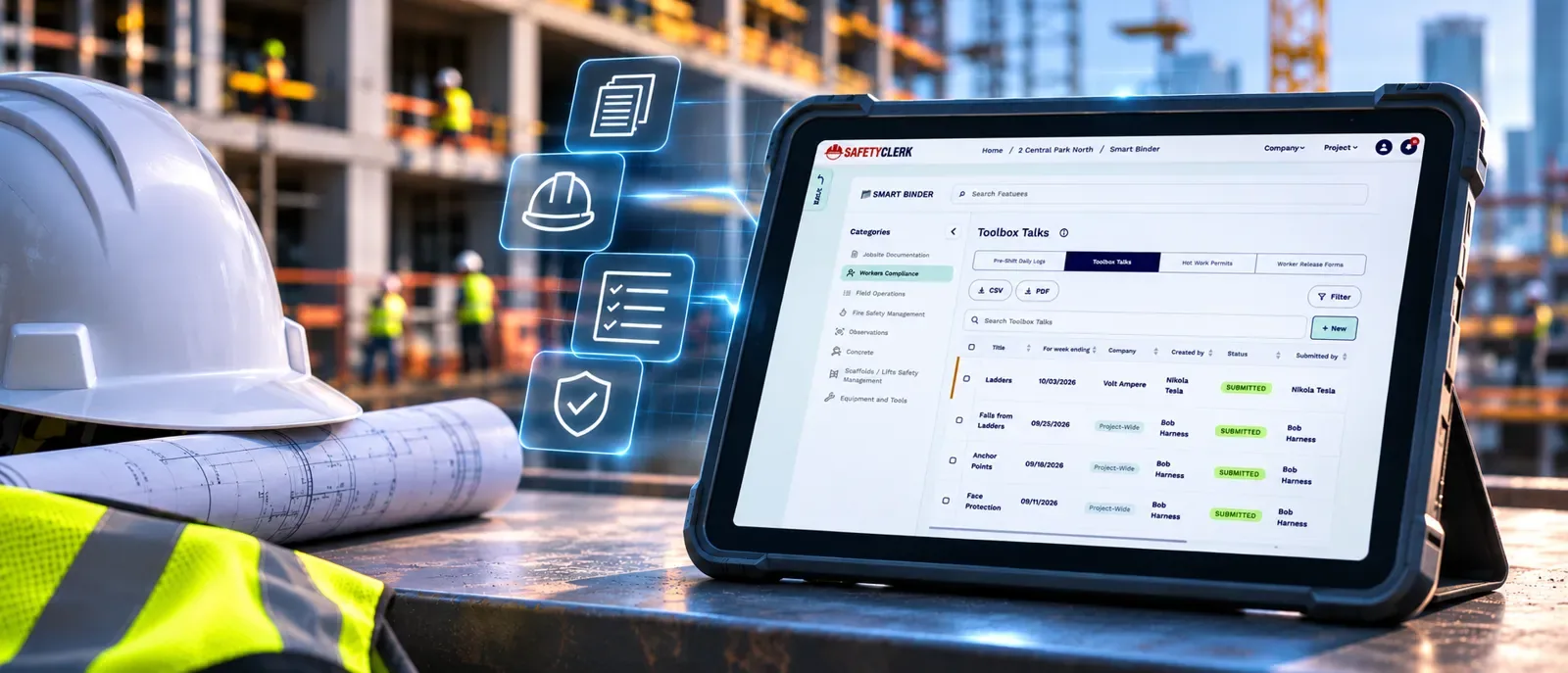
One platform. SafetyClerk manages orientations, toolbox talks, daily logs, pre-shift, incident reporting, and observations in one place.
Signed at the source. Workers get the day's pre-shift by text when they check in and sign it on their phones, so every acknowledgment carries a name and a time.
Credentials and documents. Certifications, orientations, and training live on each worker's profile, with alerts before documents expire. Every signed document is stored for claims and audits.
Subcontractors. Turnstile settings can keep out workers with expired cards or missing certifications or orientations. In New York City, SafetyClerk validates SST cards. Insurance management tracks subcontractors' certificates of insurance with real-time policy alerts, and can block entry for workers of non-compliant companies.
Operational intelligence.
- SafetyScore: gives contractors and insurers live operational visibility into jobsite risk, comparing safety performance across workers, crews, companies, and projects.
- Time tracking: puts productivity, labor costs, and compliance on one screen, with reports per site and per worker.
- Turnstiles: keep a live record of who's on site.
Proof from the field. On AECOM Tishman's 21-story tower at 729 Second Avenue, SafetyClerk recorded 36,129 pre-shift sign-offs and 4,572 toolbox talk acknowledgments across 52 subcontractors and 1,140 workers. A worker's full history comes back in three to five seconds.
Each trade's JHAs feed the pre-task plan automatically, so the foreman starts the day with the task's hazards and controls, and the record shows which plan covered which work.
Frequently Asked Questions
What safety documentation is required on a construction site? Federal OSHA requires:
- injury and illness records (Forms 300, 300A, and 301)
- written records for certain training, including fall protection, forklifts, crane operators, signal persons, confined spaces, and respirator fit tests
- crane monthly and annual inspection records
- the OSHA poster
Cities, states, owners, and GCs add more. In New York City, that includes site safety logs, orientation records, and scaffold and sidewalk shed inspections.
What records does OSHA require construction companies to keep?
The core list is above. Most OSHA training and inspection requirements say the work has to be done without requiring a written record, which is why most contractors keep records anyway. Without one, there's no proof it happened.
How long should construction safety records be kept?
- Injury and illness logs: five years.
- Crane monthly inspection records: three months. Annual records: twelve months.
- Fall protection certifications: the latest one.
- Fit test records: until the next fit test.
- NYC electronic site safety documents: up to seven years after the job.
For everything else, set a retention policy with your insurer or counsel.
Are digital safety records acceptable?
Yes, in most cases. OSHA allows computer-kept injury and illness records that can produce the required forms. New York City's DOB accepts electronic site safety documents on systems that meet Buildings Bulletin 2024-007. Federal standards say what a record must contain, not that it has to be on paper.
Does OSHA require a JHA?
No federal standard requires one. OSHA recommends job hazard analysis as a way to identify hazards, and many owners and GCs require JHAs or pre-task plans by contract.
What's the difference between an inspection and an observation?
An inspection is a planned check of an area or piece of equipment, often on a schedule a standard sets. An observation is anything anyone on site notices, at any time, from a hazard to a near miss to good work. Both should lead to a tracked corrective action when something needs fixing.
What documents should a GC collect from subcontractors?
- the sub's safety program
- training and certifications for its scope
- its named competent persons
- its inspection records and open corrective actions
- insurance certificates
- safety performance data such as TRIR and DART
This guide provides general information about federal OSHA and NYC DOB requirements and isn't legal advice. States with their own OSHA-approved plans can have additional requirements.
Turn every record into a verifiable picture of your jobsites. A SafetyClerk demo takes 30 minutes. Book a Demo









 Review us on G2
 Review us on Capterra