Key takeaways:
- Federal OSHA requires a written record for only a handful of construction training topics, among them fall protection certifications, forklift certifications, crane operator evaluations, and respirator fit tests. Most required training, including scaffold, ladder, and hazard communication training, has no record requirement, so your own records are the only proof it happened.
- OSHA's 2010 training policy tells inspectors to look past the paperwork. Training has to be in a language and vocabulary workers understand, and a signed sheet doesn't prove that on its own.
- A record that holds up answers seven things: who, what, when, where, who trained, in what language, and how the worker acknowledged it. It also has to come back years later. New York City's Department of Buildings already accepts electronic site safety records that are tamper-proof, signature-validated, and time-stamped.
A contractor can have an excellent safety manual and still be unable to answer the questions that matter after an incident, during an inspection, or in a claim:
- Who attended orientation?
- Who signed the JHA?
- Which workers received today's pre-shift?
- Which subcontractor missed training?
- What language was the training delivered in?
- When did it happen, and who conducted it?
- Can you pull the record two years later?
OSHA asks some of these questions too. Its inspectors are told to verify that training happened, and that workers could understand it, by looking beyond the paperwork. Here's what OSHA actually requires you to document, what a record needs to answer those questions, and why digital signatures, time stamps, and worker profiles turn a safety program into proof.
What OSHA Requires You to Document
Many OSHA construction standards require training. Some also spell out a written record. These are the ones general contractors and trades run into most:
| Training | What the record must show | Standard |
|---|
| Fall protection | The worker's name or other identity, the training dates, and the signature of the trainer or the employer. Keep the latest certification | 1926.503(b) |
| Forklift operators | The operator's name, the training date, the evaluation date, and who trained and evaluated. Evaluations happen at least every three years | 1910.178(l)(6), through 1926.602(d) |
| Crane operators | Completion of the employer's evaluation, with the operator's name, the evaluator's name and signature, the date, and the equipment used. Kept at the worksite while the operator is employed | 1926.1427(f)(6) |
| Signal persons | Documentation of the signal person's qualification, available at the site | 1926.1428 |
| Respirator users | Each fit test, with the worker's name, the type of test, the respirator's make, model, style, and size, the date, and the result. Kept until the next fit test | 1910.134(m)(2) |
| Confined spaces | Training records with each employee's name, the trainers' names, and the training dates, available to employees and their representatives while the employee is employed | 1926.1207(d) |
Standards for specific health hazards add their own rules. Asbestos training records, for example, have to be kept for one year beyond the last date of employment (1926.1101(n)(4)).
Much of the rest falls into a gap. General safety instruction under 1926.21(b)(2), hazard communication, scaffold training under 1926.454, and ladder training under 1926.1060 are all required, and none of them comes with a federal record requirement. Inspectors can still ask your workers what they were taught, and the only evidence you have is the record you chose to keep.
New York City adds its own layer. Local Law 196 requires Site Safety Training cards for workers on many jobsites, and the Department of Buildings checks orientation records. In December 2024, DOB issued violations against a construction superintendent for, among other failures, not having adequate site safety orientation records for the workers on site.
Training Has to Be Understood
On April 28, 2010, OSHA issued its Training Standards Policy Statement to its regional administrators. It applies to every OSHA training requirement in construction, general industry, maritime, and agriculture, and its core line is plain: an employer "must instruct its employees using both a language and vocabulary that the employees can understand."
The memo spells out what that means in practice:
- Language. If a worker doesn't speak or understand English, the instruction has to be in a language the worker understands.
- Vocabulary. If a worker's vocabulary is limited, the training has to account for that.
- Literacy. Telling workers who can't read to read the training materials doesn't satisfy the obligation.
- Consistency. If you give work instructions in a language other than English, expect to give safety training the same way.
The enforcement guidance is the part that matters for documentation. Compliance officers check that training was provided and that it was given in a format the workers could understand. They're told to look beyond basic paper documentation, because an employer may have training records that employees couldn't actually understand. If a reasonable person would conclude the training wasn't conveyed in a way workers could understand, the violation can be cited as serious.
That changes what a good record looks like. A sign-in sheet proves a worker's name is on a page. A record that shows the topic, the language it was delivered in, the trainer, and the worker's own acknowledgment comes much closer to proving the worker got it.
The Eight Questions Your Records Should Answer
1. Who attended orientation? A roster tied to each worker's identity, with the date, the project, the version of the orientation, and who delivered it. If DOB or OSHA asks about a specific worker, you should be able to pull that worker's orientation, not just a stack of sheets from that week.
2. Who signed the JHA? Federal OSHA doesn't require a JHA or pre-task plan, but many owners and GCs do, and it's the best evidence that a crew reviewed the hazards of the specific task they did that day. The record should show the task, the date, and each worker who reviewed it.
3. Which workers received today's pre-shift? Compare who signed the pre-shift with who was actually on site. The gap between those two lists is the question an inspector, an owner, or a lawyer will eventually ask.
4. Which subcontractor missed training? On a multi-employer site, a GC with control of the site is expected to use reasonable care to prevent and detect violations, including by its subcontractors. That means being able to see training, certifications, and orientations by company, before a sub's crew walks on site.
5. What language was the training delivered in? Record it. Under OSHA's 2010 policy, it's part of whether the training counts.
6. When did it happen? A date a foreman writes at the top of a sheet is weaker than a time stamp captured when each worker signs. Back-filled sign-in sheets are easy to spot and hard to defend.
7. Who conducted it? Some standards care who trains. Fall protection training has to be given by a competent person, and the certification carries the signature of the trainer or the employer. Record the trainer's name and qualification every time.
8. Can you retrieve it two years later? Most training records have no federal retention period. Claims, lawsuits, and contract disputes can surface long after the work is done, and the record only helps if you can find it.
What a Defensible Training Record Contains
OSHA doesn't prescribe this list for most training. It's what lets a record answer the eight questions above:
- The worker: name and a unique identifier, and the employer, so subcontractors' workers are distinguishable from yours.
- The project and location.
- The topic, and the version of the content delivered.
- The date and the time, captured when it happened.
- The trainer's name and qualification.
- The language, and the delivery method.
- The worker's acknowledgment, captured at the time, such as a signature.
- A comprehension check where it matters. That can be as simple as the worker answering the questions the trainer asked.
- Where the record is stored, and who can pull it.
Paper Sign-In Sheets and Digital Records
Paper sign-in sheets fail in predictable ways. Names are illegible, signatures get added after the fact, sheets get wet or lost, and nothing on the page says when each person signed. Three years later, the binder is in off-site storage, if anyone remembers which box.
Digital records close those gaps when they're built on four things:
- Worker profiles, so every acknowledgment belongs to one verified person, and that person's history sits in one place.
- Signatures captured at the time, on the worker's own device, not added at the end of the week.
- Time stamps on every signature and record, set by the system, not typed in.
- Records locked once created, stored centrally, and searchable by worker, company, project, and date.
Regulators already accept records kept this way. OSHA allows employers to keep their injury and illness records on a computer, as long as the system can produce the required forms when they're needed. In New York City, Buildings Bulletin 2024-007, issued December 19, 2024, lets jobsites keep site safety documents and sidewalk shed and scaffold inspection documents electronically, on a system that meets its conditions. The system has to be tamper-proof, validate signatures, and show when each record was created. The records must stay accessible for up to seven years after the job. Scans of paper documents and editable files don't qualify.
How Long to Keep Training Records
Federal retention rules are specific to each standard, and most training has none:
| Record | Minimum |
|---|
| Fall protection training certification | The latest certification (1926.503(b)(2)) |
| Respirator fit test record | Until the next fit test (1910.134(m)(2)) |
| Confined space training records | While the employee is employed (1926.1207(d)) |
| Forklift operator certification | No set period, but evaluations recur at least every three years (1910.178(l)(4)) |
| Crane operator evaluation | At the worksite while the operator is employed (1926.1427(f)(6)) |
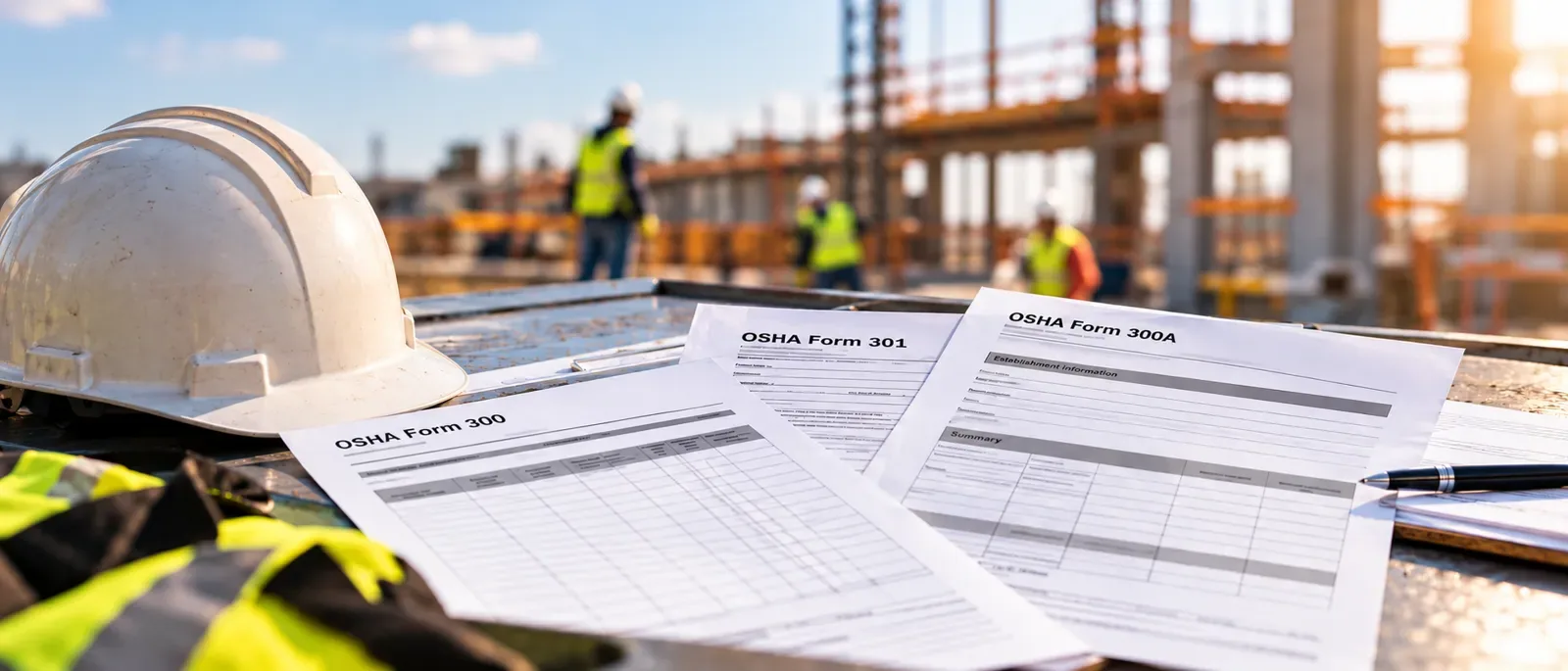
| OSHA 300 Log, 300A, and 301 reports | Five years after the end of the year they cover (1904.33) |
| NYC electronic site safety documents | Up to seven years after the job (Buildings Bulletin 2024-007) |
Because claims can arrive long after the federal minimums run out, set a retention policy with your insurer or counsel, and make it at least as long as the longest period above.
How SafetyClerk Helps
SafetyClerk keeps the records that answer the eight questions in one place. It manages orientations, toolbox talks, logs, pre-shift, and reports from one platform.
Each worker's certifications, orientations, and training live on their profile, with alerts before documents expire. Workers get the day's pre-shift by text when they check in and sign it on their phones, so every acknowledgment carries a name and a time. In New York City, SafetyClerk checks that SST cards and Worker Wallet credentials are valid. Turnstile settings can keep out workers with expired cards or missing certifications or orientations, and keep an SST daily log under Local Law 196. Every signed document is stored for claims and audits.
When DOB was weighing digital records, SafetyClerk pushed for tamper-proof records, authenticated signatures backed by a unique profile for every worker, and compliance with New York's Electronic Signatures and Records Act.
Buildings Bulletin 2024-007's conditions include tamper-proof records, signature validation, and compliance with that act. Read how SafetyClerk helped push DOB into the digital era. On AECOM Tishman's 21-story tower at 729 Second Avenue, that added up to 36,129 pre-shift sign-offs and 4,572 toolbox talk acknowledgments across 52 subcontractors and 1,140 workers. On SafetyClerk, a worker's full history comes back in three to five seconds.
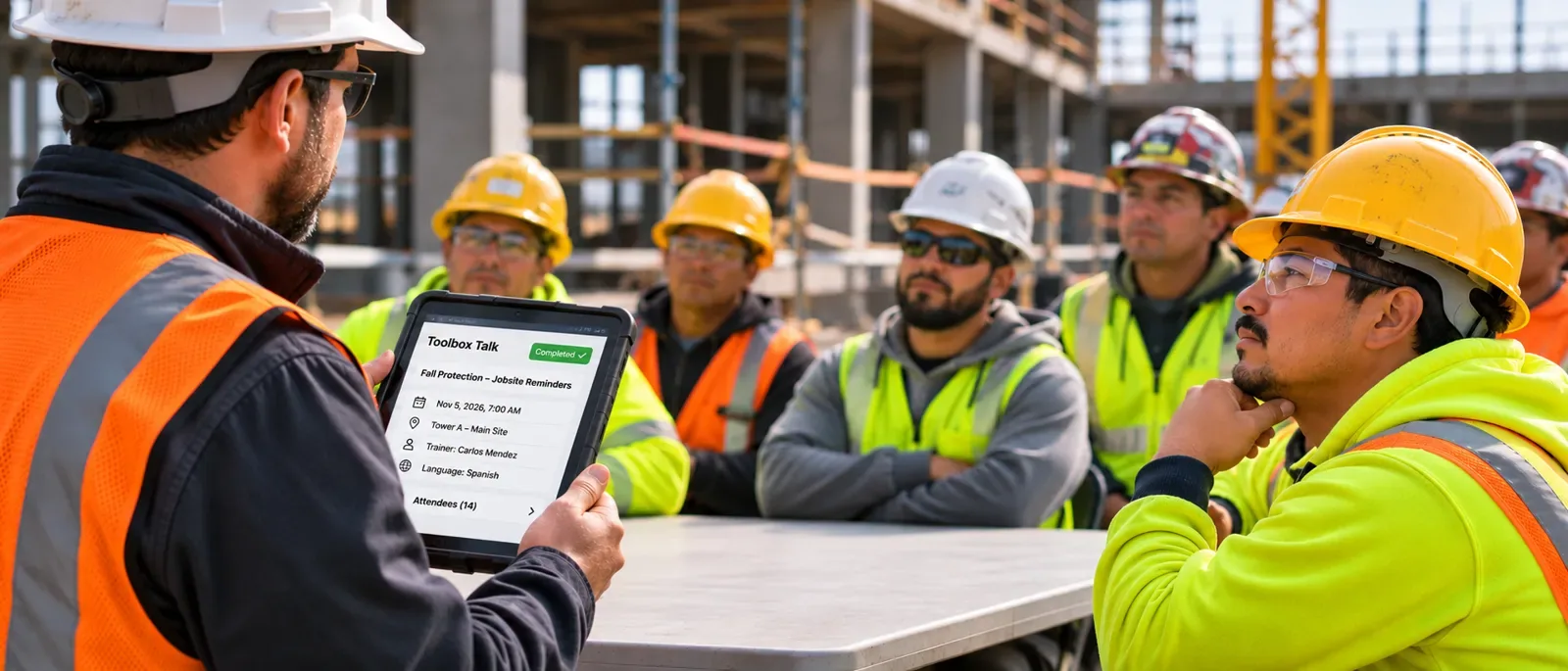
Pre-shifts and toolbox talks can be delivered in each worker's language, and the record shows which language each worker received.
Frequently Asked Questions
Does OSHA require toolbox talk documentation?
No federal standard requires a record of toolbox talks themselves. But toolbox talks often deliver training that standards do require, such as the general safety instruction under 1926.21(b)(2), and a signed, dated record is how you show it happened.
Which construction training records does OSHA require in writing?
Among others:
- fall protection training certifications (1926.503(b))
- forklift operator certifications (1910.178(l)(6), applied to construction through 1926.602(d))
- crane operator evaluations (1926.1427(f)(6))
- signal person qualifications (1926.1428)
- respirator fit test records (1910.134(m)(2))
- confined space training records (1926.1207(d))
Does safety training have to be in Spanish?
If a worker doesn't speak or understand English, OSHA's 2010 policy says training must be in a language the worker understands. For many crews, that means Spanish. The vocabulary also has to fit the workers, and workers who can't read can't be handed materials to read on their own.
Are electronic signatures acceptable for training records?
OSHA's standards say what a record must contain, such as a name, dates, and a signature. They don't require paper. OSHA already accepts computer-kept injury and illness records, and New York City's DOB accepts electronic site safety documents that meet Buildings Bulletin 2024-007. Check with counsel for your situation.
Who can conduct fall protection training?
A competent person qualified in the topics the standard lists. The certification record carries the signature of the trainer or the employer.
How long should I keep training records?
At least as long as the standard requires, which for most training is no set period. Set a policy with your insurer or counsel that covers the time claims can take to arrive. New York City's electronic site safety documents must stay accessible for up to seven years after the job.
This article provides general information about OSHA and NYC DOB requirements and isn't legal advice. States with their own OSHA-approved plans can have additional requirements.
Prove every worker got the training, in seconds. A SafetyClerk demo takes 30 minutes. Book a Demo








 Review us on G2
 Review us on Capterra