Key takeaways:
-
OSHA inspections are normally unannounced. Each one follows the same sequence: credentials and an opening conference, a walk of the site, private interviews with workers, a records review, and a closing conference.
-
Records count as much as conditions. OSHA can ask for your injury and illness logs and expect copies within four business hours, and inspectors check the training, inspection, and program records behind the standards that apply to your work.
-
Citations can arrive up to six months later. You have 15 working days from receipt to contest, an informal conference doesn't stop that clock, and 2026 penalties run up to $16,550 per serious violation and $165,514 per willful or repeated violation.
An OSHA compliance officer can walk onto your jobsite tomorrow morning without calling first. OSHA's rules allow advance notice only in narrow cases, such as an imminent danger the employer needs to fix right away. What follows is predictable. The inspector shows credentials, explains why they're there, walks the site, talks to your workers privately, and asks for records. Most contractors can handle the walk.
The records are where they get exposed, because the documentation for yesterday's workforce is spread across clipboards, binders, phones, and subcontractors' offices. Here's the checklist for every stage of an OSHA construction inspection, and a five-minute test that shows whether your records are ready.
What Triggers an OSHA Construction Inspection
OSHA can't inspect every workplace, so it works through a priority list. In order:
-
Imminent danger. A hazard that could cause death or serious physical harm. Inspectors ask the employer to correct it immediately or remove the workers exposed.
-
Severe injuries and illnesses. Reports of fatalities, in-patient hospitalizations, amputations, and losses of an eye.
-
Worker complaints and referrals. Workers can ask OSHA to keep their names confidential. Referrals come from other agencies, organizations, individuals, and the media.
-
Targeted inspections. These are aimed at high-hazard industries and at workplaces with high injury and illness rates, including OSHA's national and local emphasis programs. Falls and heat both have national emphasis programs, and the revised heat program, in effect since April 10, 2026, lists construction among its target industries.
-
Follow-up inspections. These check whether cited violations were fixed.
When inspectors arrive, the standards they cite most often in construction are no mystery. OSHA's preliminary Top 10 for fiscal year 2026, which covers October 2025 through August 2026, includes five construction standards. Fall protection, at 4,041 violations, has been first for the 16th straight year.
| FY2026 rank | Standard | Violations |
|---|
| 1 | Fall protection, general requirements (1926.501) | 4,041 |
| 4 | Scaffolding (1926.451) | 1,725 |
| 5 | Ladders (1926.1053) | 1,659 |
| 8 | Fall protection, training requirements (1926.503) | 1,273 |
| 9 | Eye and face protection (1926.102) | 1,120 |
Hazard communication (#2) and respiratory protection (#6) are general industry standards, but their requirements apply on construction sites too.
Before OSHA Arrives
Most of the inspection is decided before the inspector shows up. For every active project:
-
☐ Name the response team. Decide who greets the inspector (usually the superintendent), who calls the safety director, who walks with the inspector, and who takes notes and photos. Put the names and phone numbers in the site trailer.
-
☐ Post the OSHA poster. "Job Safety and Health: It's the Law" has to be posted where employees can see it. Inspectors check for it.
-
☐ Know where every record lives. Injury and illness logs, written programs, training and certification records, inspection records, and safety data sheets. The test is whether someone on site can produce them for a specific day and a specific crew, not whether they exist somewhere.
-
☐ Walk the site against the Top 10. Look for:
- unprotected edges, holes, and leading edges
- scaffolds that haven't been inspected by a competent person this shift
- ladders that don't extend three feet above the landing
- missing eye protection
- unlabeled containers or missing safety data sheets
- trenches without a competent person's daily inspection
- cranes behind on their shift, monthly, or annual inspections
-
☐ Check your subcontractors. On a multi-employer site, OSHA can cite more than one employer for the same hazard: the one that created it, the one whose workers were exposed, the one responsible for fixing it, and the controlling employer. A GC with general supervisory authority is expected to use reasonable care to prevent and detect violations, which in practice means regular site inspections and a way to make subs correct what they find.
-
☐ Settle the warrant question with counsel now. An employer can refuse entry. If it does, the inspector reports the refusal to the Area Director, who works with the Regional Solicitor on compulsory process, such as a warrant. Decide your policy in advance, not at the gate.
-
☐ Brief your crews. Tell workers the inspector may want to talk to them privately, that they're free to, and that they should tell the truth.
The Opening Conference
The inspection starts with credentials. Under 29 CFR 1903.7, the inspector presents them to the owner, operator, or agent in charge, explains the nature and purpose of the inspection, indicates its scope, and names the records they want to review.
-
☐ Check the credentials. If anything looks off, call the OSHA Area Office to confirm.
-
☐ Ask what brought them. A complaint, a referral, a reported injury, or an emphasis program. The answer tells you the likely scope.
-
☐ Clarify the scope. A complaint about one trench is a different inspection from a programmed inspection of the whole project.
-
☐ Call your safety director and make sure your designated representative is present.
-
☐ Know who walks. A representative of the employer and a representative authorized by employees each get the chance to accompany the inspector. The employees' representative can be a third party if the inspector finds that reasonably necessary to an effective inspection.
-
☐ Don't stall. The rule requires entry without delay at reasonable times. A brief wait for your representative may be allowed, but an unreasonable delay can be treated as a refusal.
The Site Walk
During the walkaround, the inspector can take photos, measure exposures, take samples, and use other reasonable investigative techniques.
-
☐ Stay with the inspector the whole time, and keep the walk to the areas within the inspection's scope.
-
☐ Take the same photos and notes, from the same angles, with times. If a citation follows, your record of what the inspector saw is the starting point.
-
☐ Fix what you can on the spot. OSHA can still cite a violation the employer corrects immediately. But if the inspector sees the correction within 24 hours and notes it in the citation, you won't have to certify the abatement later.
-
☐ Answer questions accurately and briefly. Don't guess, and don't volunteer opinions about what might be a violation.
-
☐ Write down everything the inspector measured or sampled, and ask for the results.
Worker Interviews
Inspectors can question any employer, owner, operator, agent, or employee privately, and they consult with employees as much as they think is necessary for a thorough inspection. During the inspection, any employee can bring a violation they believe exists to the inspector's attention.
-
☐ Let the interviews happen privately. Supervisors shouldn't hover, and nobody should be coached.
-
☐ Make sure workers know they're protected. Section 11(c) of the OSH Act prohibits retaliation against employees for exercising their rights, including talking to OSHA.
-
☐ Expect the inspector to ask about training. What fall protection they use, who trained them, when the last toolbox talk was, what was covered at that morning's pre-shift. Workers' answers either match your paperwork or they don't.
The Documents OSHA Asks For
The inspector asks for records at the opening conference and during the inspection. Which ones depends on the work, but on a construction site the list usually includes:
| Record | Where the requirement comes from |
|---|
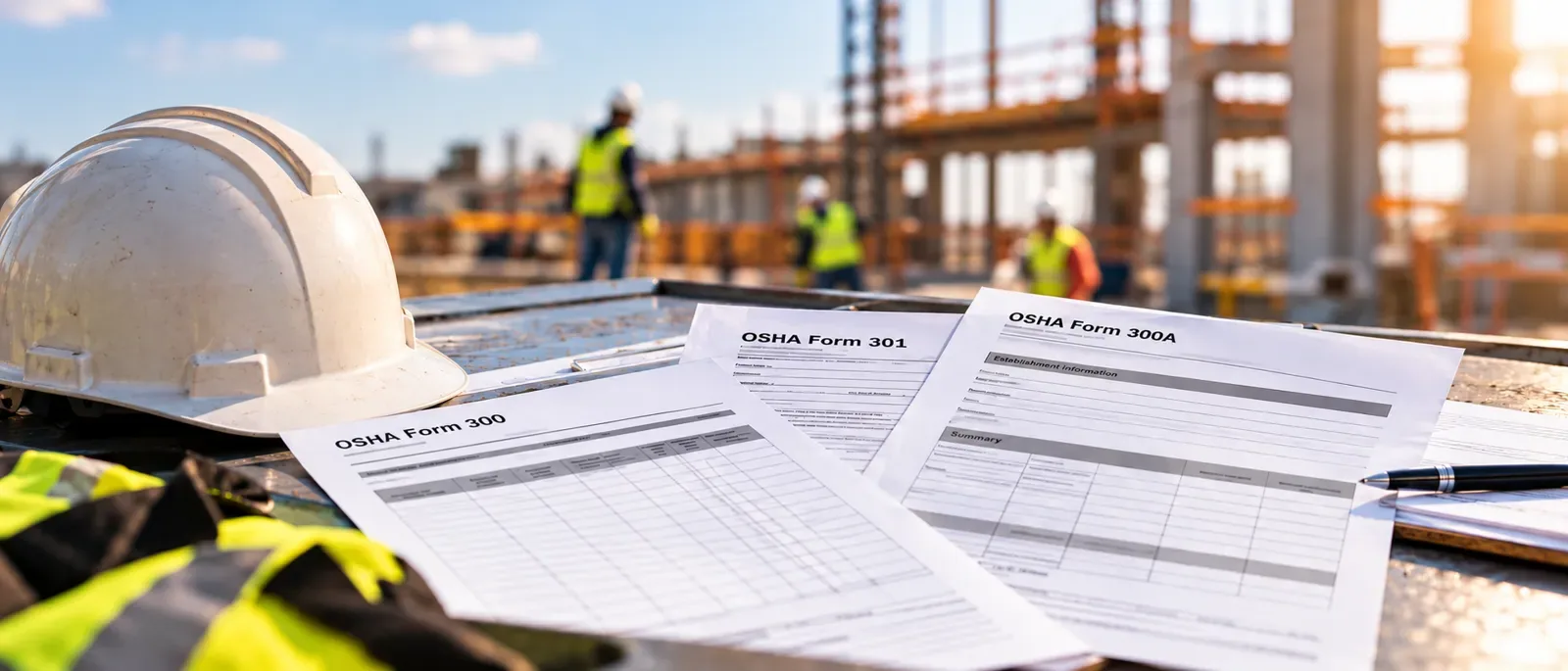
| OSHA 300 Log, 300A summary, and 301 incident reports for the past five years | 29 CFR Part 1904. Copies are due within four business hours of the request |
| The OSHA poster | 29 CFR 1903.2 |
| Written hazard communication program, labels, and safety data sheets | 1910.1200, applied to construction through 1926.59 |
| Fall protection training certifications | 1926.503(b) |
| Crane operator certifications, and monthly and annual crane inspection records | 1926.1427 and 1926.1412 |
| Respiratory protection program and fit-test records, where respirators are required | 1910.134, applied through 1926.103 |
| Written silica exposure control plan, where workers are exposed | 1926.1153(g) |
| Competent-person inspections of scaffolds before each shift, and excavations daily | 1926.451(f)(3) and 1926.651(k). Neither standard requires a written record, but a record is how you show the inspections happened |
| Your safety program, site-specific plan, orientations, JHAs, toolbox talks, and pre-shift records | Not all required by federal OSHA, but they're the evidence of how the site actually manages safety, and owners and GCs often require them |
-
☐ Give what's asked for, and keep a list of every document you hand over.
-
☐ Give copies, not originals.
-
☐ Ask for time when you need it. Injury logs are due within four business hours. For anything else, agree on a reasonable deadline rather than handing over records you haven't checked.
The Closing Conference
At the end of the inspection, the inspector meets with the employer and informally explains any apparent violations they found. You get the chance to bring up any pertinent information about the workplace.
-
☐ Write down every apparent violation, the standard it falls under, and the abatement the inspector expects.
-
☐ Raise the facts that matter: corrections already made, records the inspector didn't see, the subcontractor responsible.
-
☐ Ask about timing. Citations come later, from the Area Director, and OSHA can issue them up to six months after the violation.
After the Inspection
If OSHA issues citations, the clock starts when you receive them.
-
☐ Post each citation immediately, unedited, at or near where the violation occurred. Leave it up until the violation is abated or for three working days, whichever is longer.
-
☐ Decide within 15 working days whether to contest. The notice of intent to contest goes to the Area Director in writing and has to be postmarked within 15 working days of receiving the citation.
-
☐ Ask for an informal conference early if you want to discuss the citations, the abatement dates, or the penalties. The informal conference doesn't extend the 15-working-day deadline.
-
☐ Abate by the deadline, and certify it. Within 10 calendar days after each abatement date, certify to OSHA that the violation was corrected, with the date and method.
-
☐ Know the 2026 penalty ceilings. OSHA made no inflation adjustment for 2026, so the 2025 maximums still apply:
| Violation type | 2026 maximum |
|---|
| Serious | $16,550 per violation |
| Other-than-serious | $16,550 per violation |
| Willful or repeated | $165,514 per violation |
| Failure to abate | $16,550 per day beyond the abatement date |
OSHA can reduce proposed penalties for small employers, good faith, and history, which is one more reason a documented safety program pays off.
- ☐ Fix the system, not just the hazard. A repeated violation can carry up to ten times the serious maximum.
The Five-Minute Test
Here's the question that separates a short inspection from a long one: could you produce the documentation for yesterday's workforce in five minutes?
Pick yesterday. Pick one subcontractor. Start a timer, and try to pull:
-
☐ Who was on site, by company, with the hours they worked
-
☐ Each worker's training and certifications for the work they did, such as fall protection training, scaffold training, crane operator certification, or Site Safety Training cards in New York City
-
☐ Each worker's site orientation
-
☐ The JHA or pre-task plan for each task they performed
-
☐ The pre-shift meeting and who signed off
-
☐ The toolbox talk and who attended
-
☐ The competent-person and equipment inspections for the areas and equipment they used
-
☐ Every observation raised that day, and the corrective action, who closed it, and when
-
☐ Any incident or near miss, and where it stands in the injury log
On most paper-based sites, the answer is somewhere between "give me a day" and "I'll have to call the sub." That's the gap inspectors find. Your workers say they had a toolbox talk on Tuesday, and nobody can find the sign-in sheet. The scaffold was inspected, and the tag is missing. The sub's foreman trained the crew, and the certification lives in a binder in New Jersey.
The rule gives you four business hours for injury logs. The worker interviews happen on the spot, so the records either back up what your crew tells the inspector or they don't.
How SafetyClerk Helps
SafetyClerk keeps the records that pass the five-minute test together, by worker, by company, and by day.
Orientations, toolbox talks, pre-shift sign-offs, daily logs, incident reports, and observations live in one platform. Workers get the day's pre-shift by text when they check in and sign it on their phones, and check-in and check-out show who was on site and for how long. Certifications and inspections are tracked in one system, with automated alerts for expiring documents, and every signed document is stored for claims and audits. Access rules can keep workers without the required qualifications or certifications from getting through the turnstile at all.
On AECOM Tishman's 21-story tower at 729 Second Avenue, that came to 52 subcontractors, 1,140 workers, 36,129 pre-shift sign-offs, 4,572 toolbox talk acknowledgments, and more than 5,000 daily logs and permits over 18 months, all digital.
Each trade's JHAs feed the pre-task plan automatically, so the foreman starts the day with the task's hazards and controls, and the record shows which plan covered which work.
Frequently Asked Questions
Does OSHA give notice before an inspection? Normally, no. OSHA's rules allow advance notice only in limited situations, such as an imminent danger the employer needs to correct right away, an inspection that has to happen after hours, or one that needs special preparation.
Can I refuse an OSHA inspection? Yes. If you do, the inspector stops or limits the inspection and reports the refusal to the Area Director, who can seek compulsory process, such as a warrant. Decide your policy with counsel before an inspector arrives.
Who can go on the walkaround? A representative of the employer and a representative authorized by employees. The employees' representative can be a third party if the inspector finds that reasonably necessary to an effective inspection.
Can OSHA interview my workers privately? Yes. Inspectors can question employees privately, and federal law prohibits retaliating against employees for talking to OSHA.
What documents will OSHA ask for on a construction site? Usually:
-
the OSHA 300 Log, 300A, and 301s for the past five years, due within four business hours
-
the written hazard communication program and safety data sheets
-
fall protection training certifications
-
crane certifications and inspection records
-
respiratory protection and silica plans, where they apply
-
the records that show how the site manages safety day to day
How long do I have to contest an OSHA citation? Fifteen working days from receiving it. Requesting an informal conference doesn't extend that deadline.
What's the maximum OSHA penalty in 2026? Up to $16,550 per serious or other-than-serious violation, $165,514 per willful or repeated violation, and $16,550 per day for failure to abate. OSHA made no inflation increase for 2026.
Can a general contractor be cited for a subcontractor's hazard? Yes. Under OSHA's multi-employer citation policy, a controlling employer can be cited if it didn't use reasonable care to prevent and detect violations on its site.
This guide covers federal OSHA procedures and isn't legal advice. States with their own OSHA-approved plans follow procedures that are at least as effective but can differ. Talk to counsel about your specific situation, especially before contesting a citation or refusing an inspection.
Pass the five-minute test on every project. A SafetyClerk demo takes 30 minutes. Book a Demo










 Review us on G2
 Review us on Capterra